
The Call of the Sahara: In the Footsteps of Ancient Caravanners

4x4 Circuit, Duration 21 days
The Almoravid Route – Circuit of Ancient Cities in Mauritania
A journey through time along the caravan routes of the Sahara
Immerse yourself in the fascinating history of the great trans-Saharan caravans by following in the footsteps of the merchants, scholars, and nomads who shaped Mauritania’s destiny. This exceptional circuit takes you to discover the legendary cities of Aoudaghost, Koumbi Saleh, Oualata, Akreijit, Tichitt, Chinguetti, and Ouadane—all UNESCO World Heritage Sites, witnesses of a golden age when the trade of gold, salt, and knowledge connected sub-Saharan Africa to the Arab-Berber world.
Founded between the 11th and 12th centuries, these oasis cities were economic, intellectual, and spiritual crossroads, nurtured by Islamic faith and the Almoravid legacy. Their preserved architecture—courtyard houses, labyrinthine alleys, and mosques with square minarets—tells a thousand-year-old story where Bedouin ways of life harmoniously blended with Saharan urbanity.
Itinerary of a Cultural Epic:
Travel through breathtaking landscapes, from endless dunes to rocky plateaus, and let yourself be enchanted by the soul of these timeless cities. Each stop is a dive into nomadic traditions, the ancient manuscripts of Chinguetti, the mysterious frescoes of Oualata, or the imposing remains of Koumbi Saleh, the former capital of Ghana.
Why This Trip?
Walk in the footsteps of the caravanners who united Africa and the Mediterranean.
Decipher the Almoravid legacy, between military conquest and cultural influence.
Marvel at unique architecture, listed by UNESCO.
Experience Saharan hospitality in cities that have remained authentic.
Ready to embark on an adventure where history, desert, and culture intertwine? Follow the trail of the ancient caravanners, and let the Sahara reveal its secrets.
“The desert is not silent. It whispers the stories of lost caravans.”
About: This circuit is offered by Amatlich Tours, specialists in cultural expeditions in Mauritania.
The Itinerary: 

Arrival in Nouakchott
Beginning of your adventure in Mauritania
Upon your arrival in Nouakchott, Mauritania’s capital, our team will warmly welcome you at the airport. A private transfer will take you directly to your hotel, where you can settle in comfortably and relax after your journey.
Nouakchott, a port city nestled between the desert and the Atlantic Ocean, offers your first immersion into Mauritania’s unique culture and atmosphere. This first night at the hotel will allow you to rest and prepare for the adventures ahead.
A carefully arranged welcome experience to start your stay in peace and serenity, before setting off to discover the country’s natural and cultural wonders.

Nouakchott – Boutilimitte – Makta-Lahjar – Sangrava
We set off towards Boutilimitte, a town rich in history, dominated by its colonial fort and marked by the legacy of two great Mauritanian figures: Cheikh Sidiya, a revered scholar and founder of a prestigious library, and Mokhtar Ould Daddah, the father of the country’s independence.
The road crosses the vast expanses of the Grand Erg du Trarza, where wind-sculpted dunes unfold a mesmerizing landscape. We pass through Aleg, with its immense dried-up lake, before discovering the typical villages of Makta-Lahjar and Sangrava, witnesses to a preserved Saharan way of life.
The day ends in a bivouac under a starry sky or in a nomadic tent, for a complete immersion in the desert atmosphere.

Guerou Oasis – Kiffa
We continue our journey along the Route de l’Espoir, passing through settlements where former nomads have settled, blending pastoral traditions with modern life. Along the way, we take a detour to the Douek and Guerou oases, true emerald gems hidden in the vast Saharan expanse.
After nearly 600 km of ever-changing landscapes, we reach Kiffa, the regional capital of Assaba. From this crossroads town, an excursion to the ruins of Aoudaghost is essential: this once-flourishing caravan city bears witness to the glorious past of trans-Saharan trade routes.
The day concludes with a starlit bivouac or in a nomadic tent, lulled by the infinite silence of the desert.

Tamchakett – Aoudaghost: On the Trail of Forgotten Empires
Departure for Tamchakett, a pivotal town established in 1927, now the vibrant capital of the Afella region. Nestled 130 km northwest of Aioun el-Atrous (capital of Houd Elgharbi), this stop offers a striking contrast between administrative modernity and Sahelian traditions.
Heading to Aoudaghost, an archaeological gem
Our trail then leads to the legendary site of Aoudaghost, buried in the sands of the Rkiz region (45 km northeast of Tamchakett). What is now just a field of ruins was once:
One of Africa’s greatest caravan crossroads (8th-11th century)
A strategic hub connecting north-south (Maghreb/Ghana) and east-west routes
The temporary capital of the Almoravids at their peak
Secrets unearthed from the desert
Excavations have revealed:
✓ Sophisticated architecture attesting to an advanced urban civilization
✓ Tangible evidence of the gold trade that enriched the region
✓ Unique artifacts illustrating trans-Saharan cultural exchanges
A night of historical immersion
We set up our bivouac near the ruins, where the collapsed walls still seem to whisper tales of merchants, Almoravid scholars, and slaves en route to Timbuktu.

Tamchakett – Aioun el-Atrous – Timbedgha – Koumbi Saleh
On the Road of Hope, at the Gates of the Ghana Empire
Aioun el-Atrous: The Pearl of Hodh
After joining the legendary Road of Hope 800 km from Nouakchott, we reach Aioun el-Atrous, nestled in a vast natural basin surrounded by the majestic cliffs of Assaba, Tagant, Tichitt, and Oualata. Don’t miss the wind-sculpted rocks of Affolé Cliff, true natural works of art.
Timbedgha: Gateway to History
Our journey continues toward Timbedgha, before taking the trail leading to the legendary ruins of Koumbi Saleh, located 60 km to the south.
Koumbi Saleh: The Shadow of an Empire
3rd Century: Birth of a Giant
Founded in the 3rd century by pagan Mandingo tribes, Koumbi Saleh quickly became a vital crossroads on caravan routes linking Aoudaghost, Timbuktu, and the Maghreb.
11th Century: The Golden Age of Islam
With the arrival of the Almoravids, the city embraced Islam and became the political capital of the Ghana Empire. At its peak (11th-12th centuries):
30,000 inhabitants (the largest city in sub-Saharan Africa)
Hub of the gold trade
A thriving Islamic metropolis, with mosques and Quranic schools
15th Century: Decline
Struck by prolonged droughts and the shifting of trade routes, Koumbi Saleh was gradually abandoned, reduced to a ghostly field of ruins.
Archaeological Rediscovery
1914: French explorer Bonnier de Maizière identifies the site
1939-1950: Excavations reveal unique Islamic architecture
Today: The remains still testify to its past grandeur (palace foundations, merchant quarters, hydraulic system)
Night Under the Stars
We set up our bivouac near the ruins, where the desert wind still seems to carry echoes of merchants from times gone by.

Oualata: The Ocher Jewel of the Desert, a UNESCO World Heritage Site
A City Born of Caravans (7th Century)
Emerging from the sands in the 7th century, Oualata became one of the vital crossroads of trans-Saharan trade routes, linking Timbuktu to the Maghreb. Its rose-ocher walls have witnessed the passage of:
Gold and salt merchants
Scholars transporting manuscripts
Pilgrims en route to Mecca
An Open-Air Museum
Today, the city dazzles with its miraculous oasis and unique architecture:
✓ Pastel houses with intricately decorated facades
✓ Carved doors featuring geometric patterns inspired by Berber and sub-Saharan art
✓ Hidden libraries safeguarding ancient manuscripts
UNESCO World Heritage Site
Recognized for its intact medieval urban design and its role in Islamic history, Oualata offers a sensory immersion:
Natural dye workshops (indigo, henna)
Traditional calligraphy adorning house walls
Panoramic views from the surrounding hills
Night in a Traditional Guesthouse
We stay in a restored residence, where earthen vaults and inner courtyards preserve the Saharan art of living.
“In Oualata, every wall is an open book. The patterns dance like visual poems, telling twelve centuries of encounters between the desert and the stars.”


Tagouraret Wells – Makrougat: On the Trail of Stone Giants
The Tagouraret Wells
Our adventure begins at the Tagouraret wells, silent witnesses to the ancestral know-how of nomads in harnessing desert water. These vital water points have quenched generations of caravanners and their dromedaries.
The Elephant Rock of Makrougat
The trail leads us to an astonishing natural sculpture:
The Elephant Rock, where surrounding formations (Es Sba) appear as giant boulders eroded by wind over millennia, creating a panoramic image scattered across the desert.
The “Fingers of Es Sba”, strange rock formations rising from the sand like a petrified hand—a sacred landmark for nomads.
A Supernatural Landscape
Between erg and reg, this route reveals:
✓ Light plays transforming rocks into gold at dawn and copper at dusk
✓ Forgotten canyons where wind composes mineral music
✓ Fossil traces of a once-green Sahara
A magical night under the stars or in a nomadic tent.
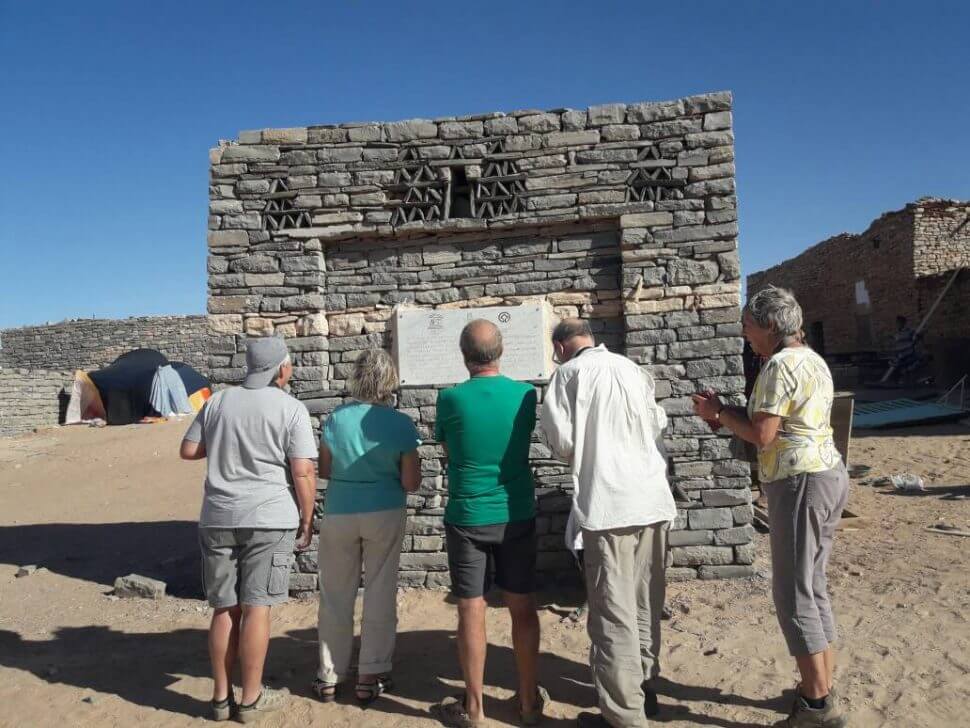
Akreijit – Tichitt: Journey to the Roots of Saharan Civilization
Akreijit: The Prehistoric Mystery
35 km east of Tichitt stands Akreijit, an exceptional archaeological site nicknamed “the dry-stone village.” This enigmatic place reveals:
- Prehistoric occupation, identified by Théodore Monod during his expeditions
- Cyclopean constructions of stacked stones without mortar
- A unique testimony to the first Sahelian settlements
“These walls speak a forgotten language—that of the desert builders before the arrival of Islam.”
Tichitt: The Miraculous City (12th Century)
A UNESCO World Heritage Site, Tichitt is a miracle of preserved architecture:
- Intact medieval urban planning for nine centuries
- Specialized districts, including the famous green-stone sector
- Cultural treasures:
✓ Ancient mosque with its typical square minaret
✓ Library safeguarding precious manuscripts
✓ Local museum showcasing the caravan golden age
Unique feature:
The “flat stone” construction technique (tabout) has endured for centuries, thanks to knowledge passed down through generations.
A Night of Historical Immersion
Overnight in a traditional guesthouse within the historic town.

Zig Wells – Lekcheb: Gateway to the Deep Desert
Zig Wells – Lekcheb: Gateway to the Deep Desert
Crossing Shifting Landscapes
Our trail plunges into an increasingly mineral desert, gradually leaving the Tagant plateau to enter a realm of sand and stone. The small Zig massif rises like a geological mirage:
Sculptural dunes embracing mountain foothills
Plays of shadow and light transforming the landscape with each passing hour
Horizon framed by dune ridges resembling petrified waves
“Here, the desert reveals its dual nature: at times soft as silk, at others harsh as stone.”
Zig Well: A Secret Place
A magical stop at the Zig Well, a strategic site for nomads:
A vital passage marked by a natural gateway between two cliffs
Rare and precious water, guarded by wind-carved rocks with tortured shapes
A timeless atmosphere, where one can still imagine caravans drinking at the cool hollow
Night at the Heart of the Elements
We pitch our nomadic tents in this natural setting for a unique sensory experience.

Lekcheb – Tidjikja: The Nomads' Trail
Winding Through the Desert
Our path snakes through:
Ephemeral camps clustered around centuries-old wells, where nomadic life still pulses
Rocky tracks where each turn reveals a new Saharan tableau
Lekcheb and Its Mineral Maze – a hallucinatory landscape where:
✓ Towering sandstone blocks appear placed by giants
✓ Golden sand corridors wind between rocks like shimmering rivers
✓ Carved shadows create a natural art gallery
“Here, the desert plays at dice: these boulders are the dice God cast when creating the Sahara.”
Tidjikja: Capital of Tagant
Arrival in Tidjikja, where tradition meets modernity:
Its colorful market: spices, fabrics, and Bedouin crafts
Its earthen architecture: ancient houses with geometric patterns
Its unique atmosphere: crossroads between nomads and settlers
Must-Sees:
✓ Panoramic views from surrounding hills
✓ Traditional leathercraft workshops
✓ Shaded alleys still echoing with caravan whispers
Night in a Traditional Guesthouse
We stay in a characteristic Tagant dwelling, where:
Banco walls naturally regulate temperature
The starlit terrace offers a final spectacle before nightfall
Mint tea is served in colorful glasses

Tidjikja – Rachid Oasis: Between Mysterious Ruins and a Living Palm Grove
The Journey to Rachid
Our trail leaves the bustle of Tidjikja and plunges into Wadi Rachid, revealing a striking spectacle:
The modern town clinging to the valley slopes, embracing monumental rock formations
The ghostly ruins of the ancient caravan city (13th century), with crumbling walls standing sentinel over the palm grove
The poignant contrast between the vibrant life of oasis gardens and the silence of abandoned stones
“Two eras face each other: date palms heavy with fruit on one side, ruins whispering history on the other.”
Rachid: Sentinel of the Caravans
Founded around 1200, this strategic city controlled:
✓ The Adrar-Tagant trade route, a vital artery for gold and salt transport
✓ A crucial watering point, now submerged beneath the modern oasis palms
✓ Cultural exchanges between Berbers and sub-Saharan peoples
Night Between History and Nature
We sleep in nomadic tents, immersed in this landscape where past and present converge.
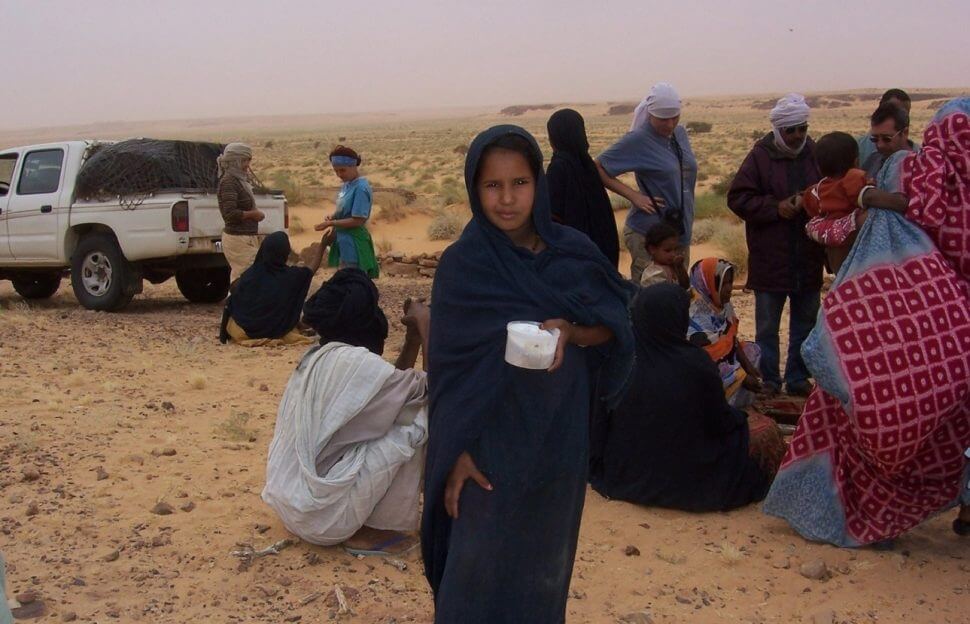
Rachid Oasis – El-Aïen Savra: On the Trail of the Stone Builders
Dawn Departure, Between Shadows and Light
We leave Rachid at first light when:
Date palms trace their silhouettes against pink dunes
Ruins seem to awaken with us, bathed in golden light
The trail winds through rugged terrain, alternating between rocky regs and glistening sebkhas
“The desert at dawn is a secret shared only with those who dare rise with the sun.”
El-Aïen Savra: The Ancient Art of Dry-Stone Construction
Arrival at the hilltop village of El-Aïen Savra, where architecture showcases millennia-old craftsmanship:
Stacked stone houses built without mortar, defying time for centuries
Starry Bivouac
We camp under open skies or in nomadic tents, immersed in this timeless landscape.

Chinguetti: Immersion in the Desert Sanctuary
Chinguetti, Spiritual Jewel of the Sahara (11th Century)
We return to the 7th holy city of Islam, where time seems to have stood still:
- Mineral architecture: Dry-stone houses with carved doors, narrow alleys winding between ocher walls
- Iconic mosque: Its square minaret (13th century), a UNESCO site, pointing skyward like a finger of light
- Timeless atmosphere: Between whispers of Quranic verses and the rustling of sands
“Here, every stone is a page of history, every corner an open-air library.”
Treasures of Ancient Libraries
Visit to sacred centers of knowledge:
- Family libraries: Manuscripts from the 12th to 19th centuries (astronomy, Islamic law, medicine) illuminated with gold and indigo
- Heritage museum: Caravan artifacts (ancient maps, navigation instruments)
- Old town: Discovery of notary houses where trans-Saharan trade contracts were sealed
Unique insight:
Some texts preserved here formed the foundation for West Africa’s first Islamic universities.
Night in a Heritage Guesthouse
We stay in a traditional inn, where the legacy of scholars and caravanners lingers in the walls.

Ouadane – Guelb er Richat: Journey to the Frontiers of History and Geology
Ouadane: The Forgotten Caravan City
An early morning departure to Ouadane, one of Mauritania’s four ancient holy cities, now a UNESCO World Heritage Site.
Old Town Exploration:
Labyrinthine alleys and stone houses with doors carved with cosmic symbols
Remnants of 16th-century grain warehouses
Caravan Museum:
Ancient maps, bronze gold weights, and astronomical instruments once used by nomads
Panoramic Viewpoint:
Overlooks both the endless desert and the haunting ruins of the city
“Ouadane was once so wealthy, its inhabitants nailed their doors shut… with gold coins.”
Guelb er Richat: The Sahara’s Enigma
Journey to the Richat Structure, a 40 km-wide geological mystery nicknamed the “Eye of Africa”:
Controversial Origins:
Ancient volcanic crater? Collapsed dome? Scientists still debate
Otherworldly Landscape:
Concentric rings in ochre, blue, and rust hues, visible from space
Local Legends:
Nomads believe it’s the footprint of the giant who created the desert
Unique Experience:
Hike along ridges to observe 100-million-year-old geological strata
Hunt for red jasper, milky quartz, and marine fossils (proof the Sahara was once an ocean)
Accommodation
Stay in a landscape-blending lodge, designed to harmonize with this surreal terrain.

Atar – Azougui Oasis – Terjit – Tifoujar Pass
Between Almohad History, Miraculous Oases and Sandstone Canyons
Atar: The Beating Heart of Adrar
Arrival in Atar, vibrant capital of the Adrar region, home to:
The country’s largest Saharan market, brimming with exotic goods typical of trans-Saharan trade
Azougui: Cradle of the Almoravids
Journey to the 11th century Almoravid capital, launching point of the dynasty that conquered Spain:
Lunar landscape: Ochre-faulted sandstone plateau
Terjit: Thermal Eden
Stop at the Terjit Oasis, a miracle of water and greenery:
Natural swimming pools (28°C) carved into red rock
Enchanted palm grove: Date palms heavy with fruit, wild grapevines
Cool cave where water drips like liquid stalactites
“After days in the desert, these waters feel divine. Nomads claim they heal rheumatism… and weary souls.”
Tifoujar Pass: Mineral Vertigo
Ascent of the sand-choked Tifoujar Pass, a geological wonder:
200m cliff towering over Wadi El Abiod
Invading dunes: Blond sand waves scaling rock walls
Light magic: At golden hour, the stone turns violet
Powerful Experiences:
✓ Hiking down the ancient fossil riverbed
✓ Watching falcons circle thermal updrafts
Starry Night in the Canyon
Nomadic bivouac at the pass foot, where:
Tents stand between boulders and shifting dunes
The silence of millennia blankets the camp

Amatlich – El Meddah Oasis: The Kingdom of Dunes and Palms
A day between living dunes and miraculous palm groves
Departure to El Gleïtat Oasis
Our trail plunges into the Amatlich erg, revealing a unique spectacle:
First living dunes of the great erg, wind-sculpted into perfect waves
El Gleïtat, a secret oasis with adobe houses nestled among palms
El Meddah: Queen of Palm Groves
Arrival at Mauritania’s largest oasis, an Eden of 200,000 palms:
Terraced date palm forest with 32 date varieties (including precious Tijib)
The Amatlich Erg
Exploration of dune ridges where:
Red dunes peak at 120m, etched by wind into ephemeral patterns
Wild palm groves appear to float on a sea of sand
Nomads still pitch seasonal camps
Night at the Erg’s Edge
Magical bivouac among the dunes of Amatlich erg, where:
The silhouettes of palms dance in moonlight
Desert winds compose dunesong lullabies

Foum Tizigui – Azoiga Oasis: The Dance of Dunes and Oases
An epic crossing between the legendary Paris-Dakar and mythical ergs
Foum Tizigui: Gateway to the Sands
Dawn departure toward the mythical pass, former playground of the Paris-Dakar Rally:
Mineral gateway carved by winds between 80m-high dunes
Historic tracks still echoing with rally engines (visible traces of old routes)
Dizzying viewpoint over the Amatlich erg – a 400km dune sea (Mauritania’s longest)
“Here, every grain of sand has been shaped by history’s winds—from medieval caravans to rally 4x4s.”
Amatlich Erg: Ocean of Red Sand
Crossing the dune massif, where landscapes shift with the winds:
Living dunes with knife-sharp crests (some reaching 150m)
Ghost oases: Sand-buried wells marked by standing stones
Unlikely encounters: Wild camel herds, stealthy fennecs
Azoiga: Mirage Made Real
Arrival at Azoiga Oasis, where the desert reveals its paradoxes:
Green fortress encircled by the Tanakhwjeritte dunes (area’s tallest)
Survival techniques: Hidden terrace gardens invisible from outside
Bivouac Beneath the Giants
Dune-oriented camp: Tents facing moonlit pink sand waves, where:
The silhouettes of palms etch the night sky
Nomad tales unfold by firelight

Akjoujt – Nouakchott: From Copper Mines to the Lights of the Capital
Akjoujt: The Desert’s Hidden Treasure
Departure toward Akjoujt, the mining town with metallic landscapes:
Spectacular geology: Verdigris and rust-colored hills contrasting with the desert’s ocher
The dramatic arrival in Nouakchott, emerging like an urban mirage
Nouakchott: Ocean of Noise and Colors
Arrival in the chaotic, vibrant capital:
Fish market: Dance of fishermen and their blue pirogues
Sunset on the beach, where the desert meets the Atlantic
Night at the Hotel

Nouakchott
We begin with a market visit, exploring the camel market—a lively and authentic local hub—followed by the National Museum, immersing us in the country’s history and culture.
A farewell dinner in the city concludes the day before your transfer to the airport.
* Price includes: 
✔ Airport welcome and transfer
✔ Accommodation
✔ Full board (all meals)
✔ Camping equipment (nomadic tents)
✔ 4×4 vehicle transportation
✔ Fuel for the 4×4
✔ Guide
✔ Cook
✔ Entrance fees to sites, museums, and libraries
* Not included in the price: 
✗ Flights and related fees
✗ Visa fees
✗ Travel assistance insurance
✗ Beverages and personal expenses, tips
✗ Any unspecified costs


Publié sur GoogleTrustindex vérifie que la source originale de l'avis est Google. Amatlich tours c'est une des meilleures expériences vous pouvez avoir en Mauritanie. Une grande expertise et connaissance du ce pays étonant et merveilleux. Jemal Abderrahman et son organisation vous offrira le lieux d'un pays pour découvrir. *****5 étoiles!!!!Publié sur GoogleTrustindex vérifie que la source originale de l'avis est Google. The proprietor is incredibly honest and kind. If you want an authentic, truly off the beaten track experience, and enjoy 4 by 4 tours, I can't recommend him highly enough. He has integrity, a love of the land, and a deep knowledge of Mauritanian culture. You will spend most nights sleeping under the desert stars, meet nomadic people, and have excellent wrap around service door to door. Jamal takes your well being as his personal responsibility.Publié sur GoogleTrustindex vérifie que la source originale de l'avis est Google. Buona organizzazione sotto tutti i punti di vista ed efficienza da parte di tutti i componenti dello staff. Ognuno ha prestato il suo servizio con cordialità disponibilità e gentilezza. Ringrazio il responsabile dell'agenzia Jamal che ci ha accompagnato per tutto il viaggio avendo cura della nostra sicurezza.Publié sur GoogleTrustindex vérifie que la source originale de l'avis est Google. nous avons fait un circuit de 13 jours, des paysages magnifiques, une excellente organisation, toujours à l'écoute de nos besoins, nous le recommandons!Publié sur GoogleTrustindex vérifie que la source originale de l'avis est Google. Muy buena experiencia!! Muy amables y muy buen acompañamiento . Merece la pena viajar con ellos! Te preparan viaje a medida!!Publié sur GoogleTrustindex vérifie que la source originale de l'avis est Google. Hemos viajado por segunda vez con estos señores y como no podía ser de otra manera han sido impecables en todo momento. Perfecto el diseño del viaje, la organización y el equipo.Totalmente recomendable viajar con estos señores.Publié sur GoogleTrustindex vérifie que la source originale de l'avis est Google. Este es nuestro segundo viaje a Mauritania con AMATLICH TOUR y ha sido fantástico. La gente de la agencia muy bien por lo que recomiendo este viaje.Publié sur GoogleTrustindex vérifie que la source originale de l'avis est Google. rien que splendide!!! merci beaucoup pour tout!!!!Publié sur GoogleTrustindex vérifie que la source originale de l'avis est Google. Un immense merci pour ce voyage, nous avions sélectionné le tour en 4x4 de la capitale jusqu à Ouadane en passant par El Meddah, chinguetty, Atar, Choum, Nouadhibou et le banc d'Arguin. Notre guide a été aux petits soins pour nous, nous a fait découvrir des lieux paradisiaques en totale immersion. Nous y avons laissé une partie de notre cœur, le pays est d'une gentillesse incomparable.Certifié par: TrustindexLe badge vérifié de Trustindex est le symbole universel de confiance. Seules les meilleures entreprises peuvent obtenir le badge vérifié, avec une note supérieure à 4.5, basée sur les avis des clients au cours des derniers 12 mois. En savoir plus